Facebook
 X
X
 Pinterest
 Copy Link
Great question! I have been getting more and more of inquires whether new build inspections are needed. Inquires include, houses have to be built to code, so why would a separate inspection be necessary?
House passes building code → Certificate of Occupancy issued → house is completely legal → but homeowner doesn’t automatically receive every available insurance credit/discount. 💰
“Built to code” and “having a specific inspection report” serve two different purposes in Florida. A house being built to the Florida Building Code means the builder was required to construct the home according to the applicable code. Having a specific inspection report “may” be an insurance underwriting requirement and/or the homeowner receiving insurance savings in the form of credits or discounts.
The insurance company angle is “Show us what features this particular house has so we can calculate the specific and appropriate insurance rate”. The important point is that the insurance company generally needs documentation of certain features, as noted below, in order to apply the appropriate ratings, credits and/or discounts. Do not assume you are getting all available insurance credits and discounts automatically (i.e same house but different elevations may result in different rates. A Latitude Margaritaville Watersound (“LMWS”) Escape model has 3 different elevations, each may result is a different insurance premium).
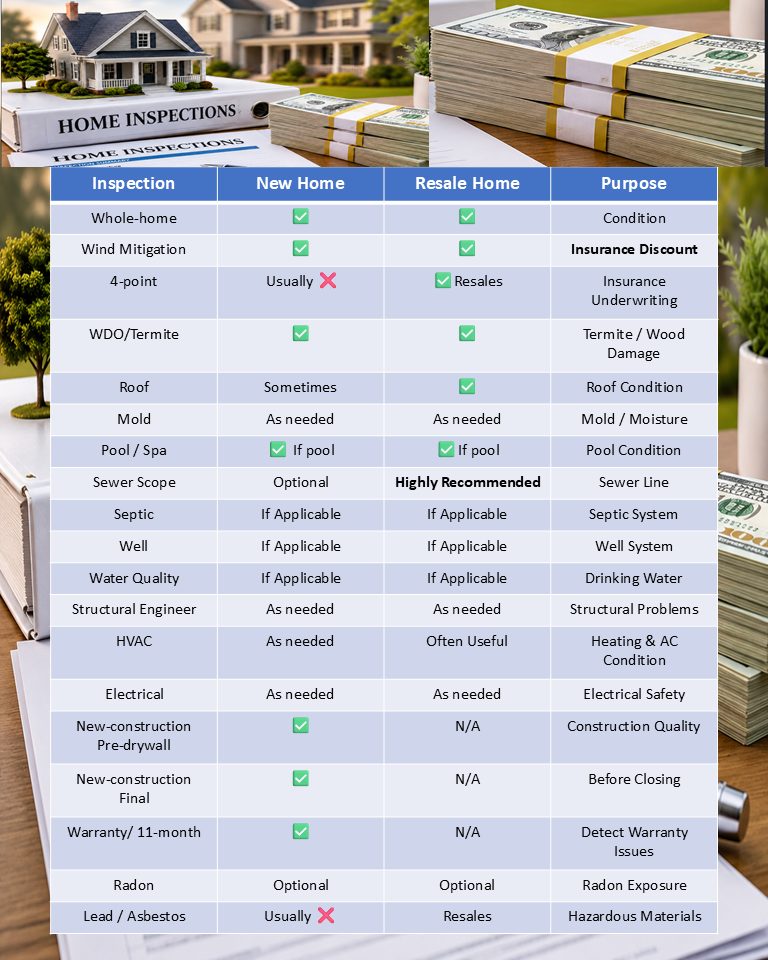
First, there are multiple inspections types as noted in the table below. This article will focus on a few inspections to “consider”.
- Whole-home
- Wind mitigation
- 4-point
- 11-month warranty inspection
Whole-home Inspection: Purpose is to assess the overall condition of the property. Items include but not limited to:
* Structure/foundation * Roof
* Attic * Electrical, Plumbing
* Appliances * Safety Issues
New construction: Yes —recommended.
Existing home resale: Yes — highly recommended.
A whole-home inspection performed by a licensed inspector may identify items not necessarily noted by the homeowner. This report is the best tool to accompany a warranty claim submission.
Wind Mitigation Inspection: Purpose is to document hurricane-resistant features for insurance underwriting and discounts/credits.
New construction: Usually worth considering. Call your insurance representative.
Existing home: Often worthwhile, particularly in coastal Florida.
Insurance discount? Yes.
“Built to code” and “having a wind mitigation inspection report” serve two different purposes in Florida. A house being built to the Florida Building Code means the builder was required to construct it according to the applicable code. Wind mitigation inspection is primarily an insurance document. It documents specific hurricane-resistant features so the insurance company can determine what windstorm premium underwriting and credits/discounts the home qualifies for. Florida specifically provides for a Uniform Mitigation Verification Inspection Form for this purpose. Even a brand-new home can have significant insurance savings depending on things such as:
- Roof shape
- Roof covering
- Roof-deck attachment
- Roof-to-wall connections
- Secondary water resistance
- Hurricane-rated windows and doors (Group A item in LMWS)
- Opening protection
The insurance company angle is “Show us what wind-resistant features this particular house has so we can calculate the appropriate insurance premium.” This is particularly relevant because if you’re in a high-wind/hurricane-exposure area. A newer home may have excellent wind mitigation features, but you don’t necessarily get the full insurance benefit simply because it was constructed under the current code. The inspection is cheap compared to year-over-year insurance savings/discounts.
LMWS homes are built in a hurricane/wind-exposure environment, but that doesn’t mean you necessarily need a separate wind-mitigation inspection simply because it’s in LMWS.
The question for insurance is what documentation will your particular insurer accept to give you the wind-mitigation credits/discounts?
That’s especially important because a new home may have documentation showing its roof, roof-to-wall connections, windows/doors, opening protection, etc. A wind-mitigation inspector may be able to verify those features and produce the insurance form.
I want to distinguish three different things:
Hurricane/wind exposure: Yes. Latitude Margaritaville Watersound is in an area where hurricane wind protection is an important building consideration.
Built to current code: Your home was permitted under the applicable Florida/Bay County building requirements, so it was designed and inspected to meet the code requirements applicable to the project.
Wind-mitigation inspection: This is primarily for insurance ratings and credits/discounts. It is not an indication that the house failed to demonstrate code compliance.
I would not automatically assume that you need to pay for a separate wind-mitigation inspection simply because the house is in Latitude Margaritaville Watersound, for example.
Since your home is new construction, I’d first ask your Builder for the documentation showing the home’s wind-resistant construction. In particular, I’d ask for:
- Final building inspection / Certificate of Occupancy
- Roof permit and roof installation documentation
- Roof-to-wall connection information
- Roof-deck attachment information
- Window, garage door and exterior-door product approvals
- Impact/opening-protection documentation
- Any wind-mitigation documentation already prepared by the Builder
Then give that package to your insurance agent and ask:
”Can you apply all available wind-mitigation credits using the builder’s documentation, or do you require an OIR-B1-1802 inspection?”
That is the question I’d ask before spending money on an inspector.
Builder documentation → insurance agent → determine credits → only then pay for an inspection if necessary.
Conduct some limited basic research, for example:
- Bay County has a specific 2023 Florida Building Code Wind-Borne Debris Map and maintains a GIS layer for the wind-debris region.
- Most importantly, Bay County states that because the county’s design wind speed is less than 140 mph, its wind-borne-debris area is limited to within 1 mile of the mean coastal high-water line of the Gulf of America.
- Latitude Margaritaville Watersound is well inland from the Gulf shoreline. A current mapping source places the community around 30.307° N, 85.866° W, on the north side of West Bay.
LMWS homes are absolutely in a hurricane-prone coastal region, but it isn’t the same thing as being in the special Gulf wind-borne-debris zone.
Your new Latitude home was built under current Florida/Bay County requirements, but an OIR-B1-1802 wind-mitigation inspection can still be useful because it documents features for insurance ratings and credits/discounts.
4-point Inspection: Primarily for insurance underwriting.
It documents to condition of: 1) Roof 2) Electrical 3) Plumbing and 4) HVAC
New construction: Usually unnecessary.
Older or resale home: Frequently requested by insurers.
Insurance discount? Not primarily a discount inspection. It is more about whether the insurer will underwrite the policy and under what conditions. Florida DFS describes this as something insurers may require, particularly for older or resale homes.
I would not pay for a 4-point inspection just to get an insurance discount. But please discuss with a licensed insurance representative. 💵
Instead, the inspection that potentially produces meaningful hurricane/wind discounts is the OIR-B1-1802 wind-mitigation inspection discussed earlier.
11-month warranty inspection:
Near the end of the builder’s one-year warranty period.
This can be particularly valuable because it gives the homeowner a chance to identify defects/repairs before the builder’s warranty expires.
Re-inspect the whole house. Inspection is cheap compared to repairs required. You have owned and lived in the home for nearly a year. As they say, “c’est la vie”.
- Look for evidence of: Subterranean termites and other wood-decaying organisms/fungi
- Foundation cracks, settlement, rood structure, load bearing walls
- Roof leaks, rain or storm damage
- Plumbing leaks
- Mold
- Pool and spa leaks plus related equipment defects
- Home automation devices
- Scope plumbing: cracked pipes, blockages, improper connections
- Overloaded circuits
- Check for HVAC refrigerant leaks, coils, ductwork separation, condensate drainage, airflow, efficiency
- Gas fireplaces, chimney, gas connection
- Missing insulation
- Plus items discussed previously
Talk to your inspector as this may be your last chance for warranty claims!
Summary
- Whole-home Inspection
- Does my insurance company require this inspection
- Use report for Warranty Claim
- Wind mitigation
- Obtain documentation from Builder
- Discuss Builder Documentation with Insurance Representative
- Obtain report from inspector if required for insurance discounts
- 4-point
- Does my insurance company require this inspection
- 11-month Warranty Inspection
- Cheap insurance for last chance at warranty claim 💲
Please consult with your Builder and Insurance Representative on any topics discussed in the blog. The purpose of this document is to provide some basic awareness and is not meant to be an all-inclusive document in all new build situations.
Call me as I would be happy to help explore your new home.
Mobile: 813-845-4042 or email: joebogdan@c21be.com